
How MSSPs Prevent and Detect Business Email Compromise (BEC) Attacks
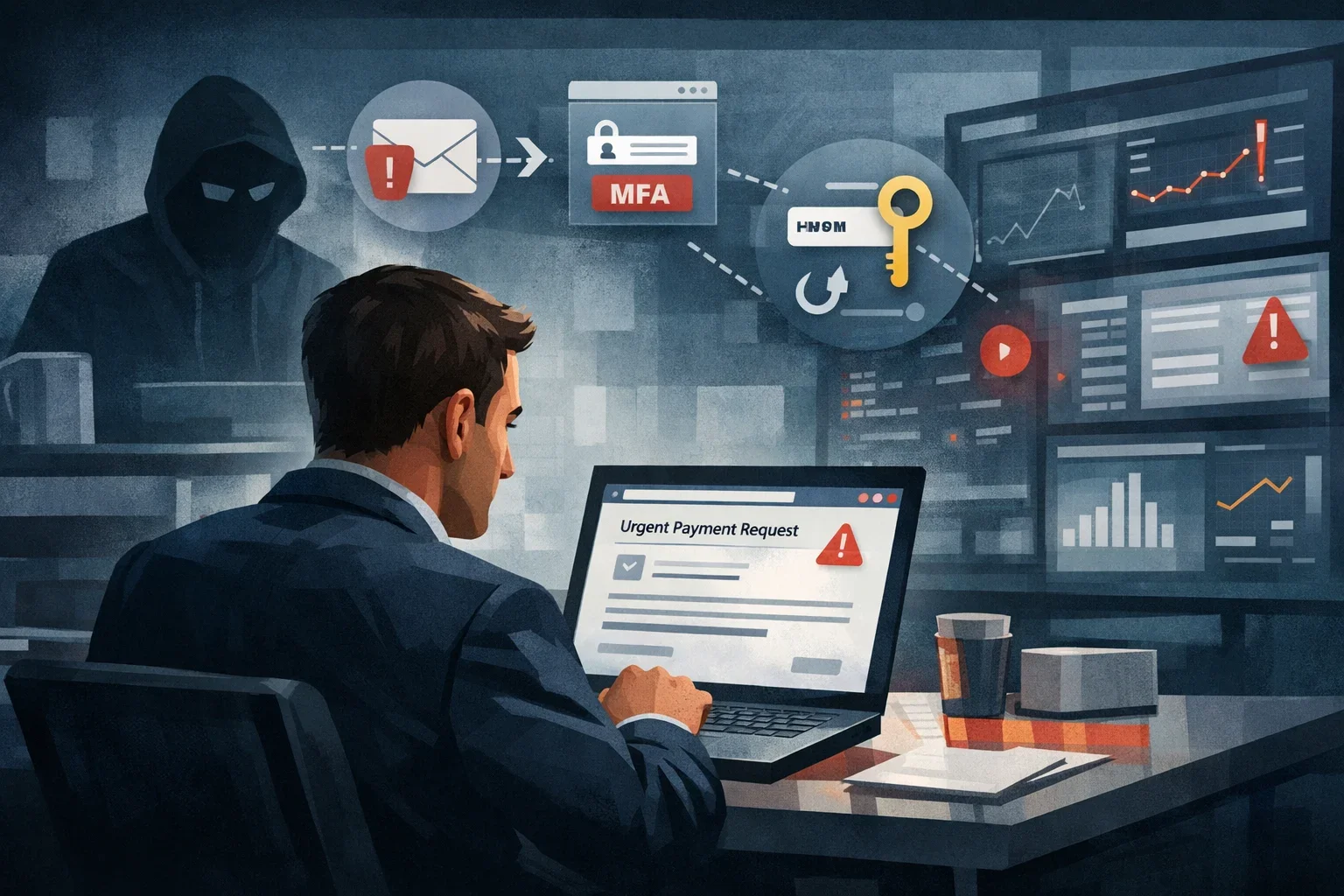
A finance manager receives an urgent email from the CEO. The message is direct, professional, and consistent with the executive's writing style. It requests a wire transfer to a new vendor account — time-sensitive, confidential, not to be discussed with others. The finance manager processes the transfer. The money is gone within minutes, irretrievably routed through a chain of accounts designed to defeat recovery efforts. The CEO never sent the email.
Business Email Compromise is not a sophisticated technical exploit. It does not require the attacker to breach a firewall, plant malware, or circumvent complex security controls. It requires only a convincing email and a recipient who trusts it. That simplicity is precisely what makes it so effective — and so expensive. The FBI's Internet Crime Complaint Center has consistently ranked BEC among the costliest categories of cybercrime, with losses measured in the billions of dollars annually across organizations of every size and industry. A Managed Security Services Provider (MSSP) addresses BEC through a layered combination of technical controls, process enforcement, and continuous monitoring that individual organizations struggle to sustain on their own.
Understanding How BEC Attacks Work
BEC attacks succeed by exploiting two things that organizations cannot simply turn off: trust in executive communications and pressure to act quickly on time-sensitive requests. Attackers invest significant effort in the reconnaissance phase — studying an organization's leadership structure, understanding financial workflows, identifying the employees with payment authorization, and observing communication patterns that allow them to craft messages that feel authentic.
The attack itself may take several forms depending on what the attacker has learned about the target. What unites them is the exploitation of human judgment under pressure, combined with technical spoofing or account compromise that makes the communication appear legitimate.
The Primary BEC Attack Patterns
CEO Fraud and Executive Impersonation
The most widely recognized BEC variant involves an attacker impersonating a senior executive — typically the CEO, CFO, or another officer with authority to direct financial activity — and sending a fraudulent payment request to an employee in accounts payable, finance, or treasury. The message typically conveys urgency, requests confidentiality, and discourages the recipient from following normal verification procedures by framing them as unnecessary bureaucracy or a time constraint.
These emails may be sent from a domain that is visually similar to the legitimate corporate domain — a technique called typosquatting — or from a free webmail account with a display name matching the executive's. In more sophisticated attacks, the executive's actual email account has been compromised, and the fraudulent request arrives from the legitimate address.
Vendor and Invoice Fraud
In vendor impersonation BEC, attackers research an organization's existing supplier relationships and send fraudulent payment instructions that appear to come from a known vendor. The message typically advises that the vendor's banking details have changed and requests that future payments be directed to a new account. Because the request references a real vendor relationship and real outstanding invoices, it bypasses the skepticism that might greet a message from an unknown sender.
This attack variant is particularly difficult to detect because it does not require impersonating an internal executive — the fraudulent communication mimics an external relationship that finance staff interact with regularly.
Account Compromise-Based BEC
The most damaging BEC attacks begin with an actual compromise of a legitimate email account — typically through phishing, credential stuffing, or malware that captures login credentials. With access to a real inbox, attackers can monitor ongoing communications, identify pending transactions, and intervene at precisely the right moment with fraudulent payment instructions that appear to come from the verified, trusted account. Compromised accounts also allow attackers to set up forwarding rules that provide persistent visibility into communications even after the initial access point is addressed. CyberSecOp's Dark Web Monitoring service provides early warning when employee credentials appear in breach databases — enabling password resets before compromised credentials can be used to access corporate email.
Payroll Diversion
Payroll diversion attacks target HR and payroll departments rather than finance teams. An attacker impersonates an employee and requests a change to their direct deposit banking information — redirecting their next payroll disbursement to an attacker-controlled account. Because payroll change requests are routine and expected, they may receive less scrutiny than large wire transfer requests. The losses per incident are typically smaller than in CEO fraud cases, but the volume of potential targets within any organization is significantly larger.
Attorney and Legal Impersonation
In this variant, attackers impersonate attorneys or legal representatives — often claiming to be handling a confidential acquisition, compliance matter, or regulatory investigation that requires an urgent and discreet financial transaction. The authority and urgency implied by legal involvement, combined with the confidentiality framing that discourages consultation with colleagues, makes this a particularly effective social engineering approach against executives who might otherwise apply more scrutiny.
Why BEC Is So Difficult to Stop Without a Managed Program
BEC attacks are effective precisely because they work with the grain of normal business operations rather than against it. Wire transfers happen. Payment instructions change. Executives make urgent requests. Vendors update their banking details. The attacker's task is to make a fraudulent communication indistinguishable from a legitimate one — and in many cases, they succeed.
Technical controls alone cannot fully address this. A sophisticated BEC email sent from a compromised legitimate account will pass email authentication checks. An impersonation sent from a carefully crafted lookalike domain may evade filters that are not configured to detect subtle domain variations. And even when technical controls flag a suspicious message, a recipient under pressure may override the warning and act anyway.
Effective BEC defense requires a combination of technical controls that make impersonation harder, monitoring that identifies anomalous financial activity and suspicious email patterns, process controls that enforce verification procedures regardless of apparent urgency, and employee awareness that prepares staff to recognize and respond correctly to BEC attempts.
How an MSSP Prevents and Detects BEC
Email Authentication and Domain Protection
The technical foundation of BEC prevention is email authentication — a set of standards that allow receiving mail servers to verify that an email claiming to come from a given domain actually originated from an authorized sender for that domain. SPF, DKIM, and DMARC are the three primary standards, and their effective deployment requires careful configuration and ongoing monitoring to prevent both spoofing of the organization's own domain and to ensure that fraudulent emails impersonating the organization are rejected rather than delivered.
An MSSP deploys and maintains email authentication standards across the organization's domain portfolio — including secondary domains that may be less carefully managed than the primary domain. CyberSecOp also monitors for the registration of lookalike and typosquatting domains that attackers commonly use in BEC campaigns, providing early warning through its Attack Surface Management service before those domains are used in active attacks.
Advanced Email Security and BEC-Specific Filtering
Standard spam and phishing filters are insufficient for BEC detection because many BEC emails contain no malicious links or attachments — the attack payload is the text of the message itself. Advanced email security platforms use natural language processing, behavioral analysis, and communication graph analysis to identify BEC-pattern emails based on the characteristics of the request rather than the presence of technical indicators of compromise.
These controls detect impersonation attempts by analyzing display name spoofing, domain similarity, sender reputation, and communication patterns that deviate from an employee's established relationship history. Managed and continuously tuned as part of CyberSecOp's Managed Security Services, these filters are updated against current BEC campaign techniques rather than static rule sets that attackers quickly learn to circumvent.
Account Takeover Detection and Response
Detecting a compromised email account — one that an attacker is using for BEC from within the legitimate inbox — requires behavioral monitoring that identifies usage patterns inconsistent with the account owner's normal activity. Logins from unexpected geographies, access at unusual hours, mass email reading or forwarding rule creation, and communication pattern anomalies are all indicators of account compromise that CyberSecOp's Security Operations Center monitors for across the organization's email environment. When a compromised account is identified, rapid response limits the window during which the attacker can use it for BEC or other fraudulent activity.
Financial Transaction Monitoring and Controls
BEC prevention requires controls that extend beyond the email channel into the financial workflow itself. An MSSP works with organizations to implement process controls that enforce verification requirements for financial transactions regardless of the apparent authority or urgency of the request — out-of-band confirmation for payment instruction changes, dual-approval workflows for wire transfers above defined thresholds, and callback verification procedures that use known, pre-established contact information rather than details provided in the suspicious communication.
These procedural controls are the last line of defense when technical controls have been bypassed — and they are the controls that most frequently prevent BEC losses that would otherwise be unrecoverable.
Targeted Security Awareness Training
Finance staff, executives, HR personnel, and anyone with payment authorization authority are the primary targets of BEC campaigns. Generic phishing awareness training is insufficient preparation for the specific social engineering techniques used in BEC attacks. CyberSecOp's Security Awareness Training programs include BEC-specific content and simulated BEC exercises — exposing staff to realistic attack scenarios that build recognition and correct response behaviors before a real attack tests those skills. Training emphasizes the critical importance of verification procedures and establishes a clear organizational norm: urgency and confidentiality requests are themselves warning signs, not reasons to bypass controls.
Incident Response When BEC Succeeds
When a BEC attack results in a fraudulent transfer, the speed of response is the primary determinant of how much of the loss can be recovered. The FBI's Financial Fraud Kill Chain — a rapid notification process involving the sending financial institution, the FBI, and the receiving bank — has a meaningful success rate when initiated within hours of a fraudulent transfer. After 72 hours, the probability of fund recovery drops dramatically. CyberSecOp's Incident Response Services are structured to activate immediately when a BEC event is identified — initiating the recovery notification chain, preserving forensic evidence, containing any associated email account compromise, and coordinating with law enforcement where appropriate.
vCISO-Level Policy and Governance
BEC prevention requires organizational policy changes — authorization thresholds, verification requirements, and communication protocols — that need executive sponsorship and consistent enforcement to be effective. CyberSecOp's Virtual CISO Program provides the strategic leadership to develop, implement, and maintain these policies as part of a coherent financial fraud prevention program, ensuring that process controls keep pace with evolving BEC techniques.
The Human Factor Cannot Be Engineered Away
BEC is fundamentally a human attack — it succeeds by exploiting trust, authority, and urgency in ways that bypass both technical controls and rational scrutiny. No technology eliminates this attack surface entirely. What a managed security program does is make impersonation technically harder, make suspicious patterns visible before a transfer is completed, and build the organizational culture and process discipline that causes employees to pause, verify, and escalate rather than act under pressure.
The organizations that successfully resist BEC campaigns are those that have invested in all three layers — technical controls, monitoring, and human preparedness — and have maintained them as a continuous program rather than a one-time deployment. Begin with a Cybersecurity Assessment to evaluate your current BEC risk posture across email security, financial controls, and employee awareness. Contact CyberSecOp at cybersecop.com/contact to speak with a member of our team.