
Managed SOC vs. In-House SOC: Which Is Right for Your Organisation?
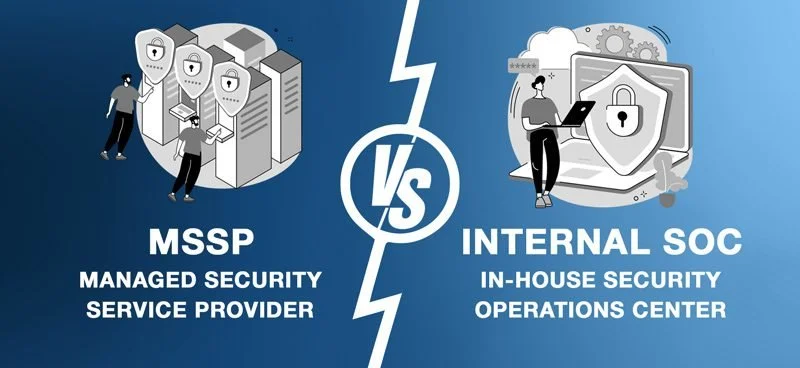
At some point in every organization's security maturity journey, the same question surfaces: should we build our own Security Operations Centre, or should we engage a managed SOC provider? It is a significant decision, one that touches budget, talent strategy, technology investment, and the organization's risk tolerance. And it is one that many organizations approach without a clear picture of what each option actually costs and delivers in practice.
This guide compares in-house and managed SOC options across the factors that matter most, cost, coverage, staffing, technology, scalability, and response capability, so that your organization can make an informed choice. CyberSecOp's managed SOC services are built for organizations that have worked through exactly this comparison and concluded that the managed model delivers better outcomes at lower risk.
What Is a Security Operations Centre?
A Security Operations Centre is the function responsible for continuous monitoring of an organization's security environment, detecting threats, investigating alerts, and coordinating the response to confirmed incidents. Regardless of whether a SOC is in-house or managed, it requires three things to be effective: people with the skills to identify and respond to threats, technology to collect and analyze security data, and processes that ensure consistent, repeatable response to the full range of threat scenarios an organization faces.
The performance gap between a well-resourced, mature SOC and an understaffed or poorly tooled one is enormous. A SOC that cannot investigate alerts quickly, that lacks the expertise to distinguish genuine threats from false positives, or that has no tested playbooks for common attack scenarios will routinely fail to detect or contain the threats it exists to address. CyberSecOp's Security Operations Centre is built to close these gaps for organizations that cannot build that capability on their own.
The In-House SOC: What It Actually Requires
Building an in-house SOC is frequently presented as the premium option, the approach that gives an organization full control and maximum customization. The reality is more complex. The requirements for a functional in-house SOC are substantial, and the organizations that pursue this path often underestimate both the cost and the operational difficulty of sustaining it.
Staffing Requirements and Talent Scarcity
A 24/7 SOC requires enough analysts to cover all shifts without relying on individuals to work unsustainable hours. Industry guidance typically suggests a minimum of eight to ten analysts for genuine around-the-clock coverage, accounting for shift patterns, leave, sick time, and the turnover that is endemic to the security operations profession. Senior analysts and a SOC manager add to the headcount requirement.
This staffing requirement collides with a structural market reality: experienced SOC analysts are among the most sought-after professionals in the technology labor market. Recruiting and retaining qualified personnel requires competitive salaries, meaningful career development opportunities, and a work environment that does not burn analysts out through excessive alert volumes and inadequate tooling. Organizations that build SOCs without addressing these factors typically experience high turnover, persistent vacancies, and the coverage gaps that follow.
Technology and Platform Costs
A functional SOC requires a SIEM platform to collect and correlate log data, endpoint detection and response tools across the device fleet, network monitoring capabilities, threat intelligence feeds, and case management and orchestration platforms that coordinate analyst workflow. The licensing, implementation, and ongoing maintenance costs for this technology stack are significant. CyberSecOp's SIEM-as-a-service and managed detection and response capabilities reflect the investment required to build and maintain this infrastructure at an enterprise level.
The Alert Fatigue Problem
A fully deployed security monitoring stack generates an enormous volume of alerts, far more than an adequately staffed team can investigate with the depth each alert deserves. Alert fatigue, the desensitization that occurs when analysts must process thousands of low-quality alerts to find genuine threats, is a primary cause of missed detections and analyst burnout. Addressing it requires ongoing tuning of detection rules, suppression of known false positives, and the institutional knowledge about what normal looks like in a specific environment that takes months or years to develop.
The Knowledge Breadth Challenge
The threat landscape a SOC must monitor spans network-based attacks, endpoint compromises, cloud environment misconfigurations, identity-based intrusions, application vulnerabilities, and social engineering campaigns. No individual analyst has deep expertise across all of these domains. An in-house SOC of ten analysts is unlikely to have genuine specialists in all of them, which means some threat categories will be monitored by generalists rather than experts.
The Managed SOC: What It Delivers
A managed SOC provider operates a security operations function on behalf of multiple client organisations, providing 24/7 monitoring, threat detection, investigation, and response coordination as a service. CyberSecOp's managed SOC delivers this capability to organizations across industries, with detection and response tuned to the specific threat profiles of each client's environment.
Immediate Access to Established Expertise
A managed SOC provider has already built what an in-house SOC takes years to develop: an experienced analyst team, mature detection playbooks, tested incident response procedures, and a threat intelligence operation that tracks adversary activity across all client environments simultaneously. From the first day of engagement, the client organization benefits from this institutional maturity, without the years and investment required to build it internally.
Cross-Client Threat Intelligence
One of the structural advantages of the managed SOC model is the threat intelligence benefit of monitoring multiple organizations simultaneously. When a new attack technique is used against one client, the managed SOC provider identifies it, updates detection logic across all clients, and the benefit is shared immediately. An in-house SOC sees only what happens in one environment, a managed SOC provider sees what is happening across dozens or hundreds.
Technology Infrastructure at Scale
A managed SOC provider has already made the technology investments that an in-house SOC requires and amortizes those costs across its entire client base. The client organization gets access to enterprise-grade security technology, SIEM, EDR, network detection, threat intelligence, orchestration, and automation, without the capital expenditure, implementation project, or ongoing maintenance burden of owning it.
Scalability Without Hiring Cycles
Organizations grow, acquire businesses, expand into new geographies, and adopt new technology platforms. An in-house SOC must grow its headcount and technology footprint to keep pace, a process that involves hiring cycles measured in months. A managed SOC scales with the client's environment immediately, without the friction of internal procurement and hiring.
Side-by-Side Comparison
The following comparison covers the factors most relevant to the build-vs-buy decision. Costs are indicative ranges and will vary by organization size, industry, and market.
Annual cost (24/7 coverage): In-house: $1.5M–$3M+ including salaries, benefits, technology licensing, and infrastructure. Managed SOC: $80K–$400K annually depending on environment size and service tier.
Time to operational: In-house: 12–24 months from decision to functional 24/7 coverage. Managed SOC: 4–8 weeks from contract to active monitoring.
Analyst team depth: In-house: 8–12 analysts for genuine 24/7 coverage; expertise breadth limited by team size. Managed SOC: Full analyst team with specialists across network, endpoint, cloud, identity, and threat intelligence.
Technology stack: In-house: Separate procurement, implementation, and maintenance of SIEM, EDR, network monitoring, and orchestration platforms. Managed SOC: Enterprise-grade stack included; no capital expenditure or maintenance burden.
Threat intelligence: In-house: Limited to what the organization's own subscriptions and team provide. Managed SOC: Cross-client intelligence from monitoring multiple environments simultaneously.
Scalability: In-house: Requires hiring cycles and technology projects; lags behind growth. Managed SOC: Scales with the client environment on the existing contract.
Staff turnover risk: In-house: High; security analyst turnover averages 20–30% annually; departures create coverage gaps. Managed SOC: Managed by the provider; client continuity is unaffected by individual staffing changes.
Compliance reporting: In-house: Requires dedicated effort to produce audit-ready reporting. Managed SOC: Most providers include compliance-aligned reporting as part of the service.
When Does an In-House SOC Make Sense?
The in-house model is appropriate in a narrow set of circumstances. Very large enterprises with highly specialized security requirements, where the organization's threat profile is sufficiently unique that a managed provider cannot adequately tune detection, may justify the investment. Organizations with regulatory constraints that prohibit third-party access to security telemetry may have no alternative. And organizations that have already built a mature in-house SOC may find it more cost-effective to continue than to migrate.
For the vast majority of organizations, including SMBs and mid-market companies, the in-house SOC model is not a realistic path to the coverage it promises. The staffing costs are prohibitive, the talent market is hostile, and the technology investment is substantial. The organizations that pursue it anyway frequently end up with an under-resourced function that provides a false sense of security rather than genuine coverage.
The Hybrid Approach
Some organizations combine elements of both models, maintaining an internal security team for incident ownership, escalation, and organizational context while outsourcing the continuous monitoring function to a managed SOC provider. This approach gives internal teams the strategic and operational control they want while leveraging the managed provider's 24/7 coverage, tooling, and analyst depth. CyberSecOp's managed SOC services are designed to work collaboratively with internal security teams, functioning as an extension of the team rather than a replacement for it.
Making the Decision
The right choice depends on your organization's budget reality, talent market position, growth trajectory, regulatory environment, and risk tolerance. For most organizations, the honest assessment of what a genuine in-house SOC requires, and what it costs to sustain, leads to the same conclusion: the managed model delivers better coverage, at lower cost, with less operational risk.
CyberSecOp's managed SOC services provide 24/7 threat monitoring, investigation, and response coordination backed by a team of security specialists and enterprise-grade technology infrastructure. A cybersecurity assessment establishes the current security baseline and informs the scope and configuration of the managed service. Contact us at cybersecop.com/contact to discuss your requirements.